All models
Semicircular canals in motion
A hands-on view of the vestibular system, connecting inner-ear anatomy with head movement and simulated responses.
Open the model
Use a mouse or touch to explore. A larger screen is recommended for comparing the model and its plots.
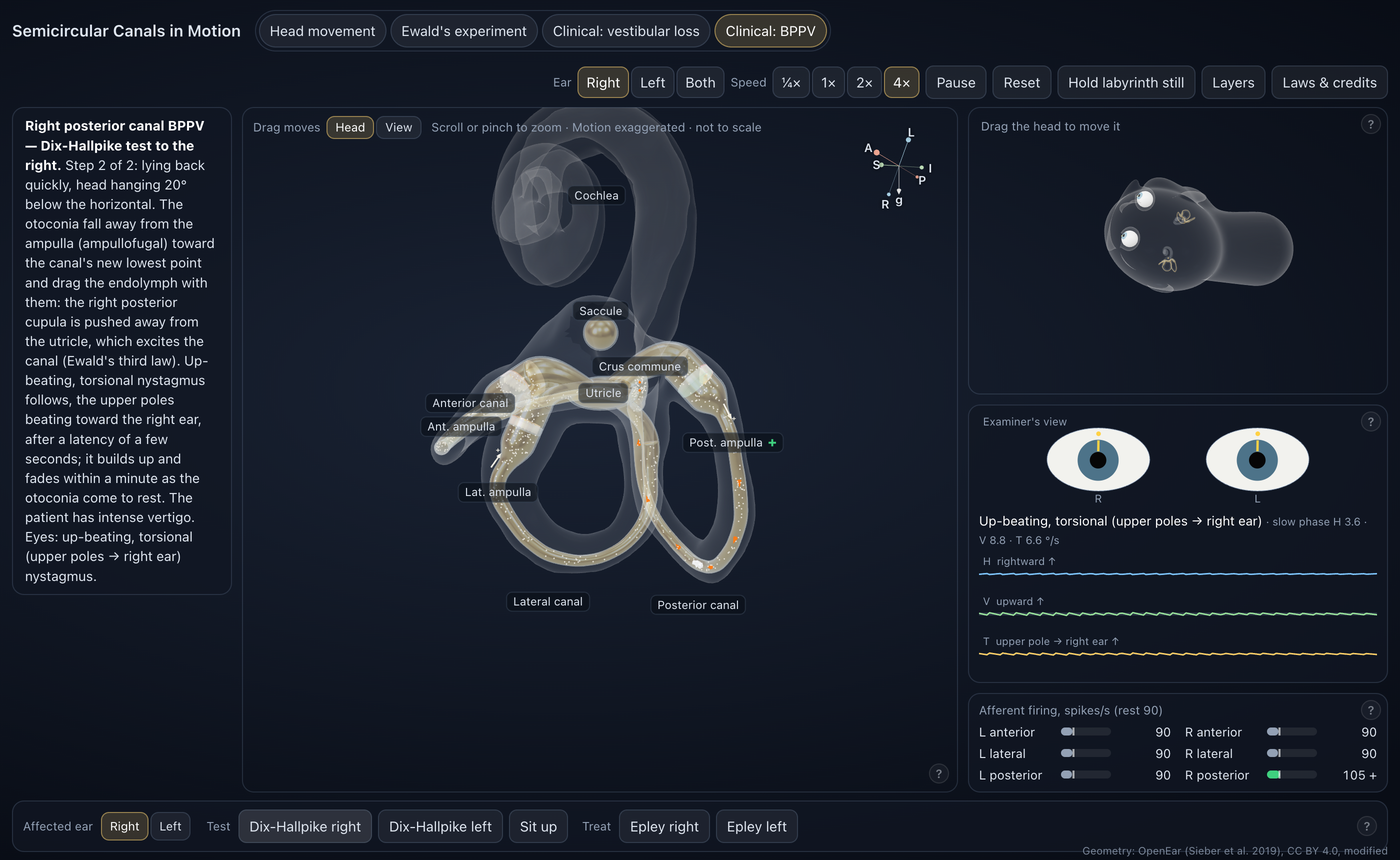
The model during a Dix-Hallpike test for BPPV of the right posterior canal.Open full screen
- Body system
- Vestibular system
- Cost
- Free, with no account
- Runs in
- Your browser, nothing to install
- Works with
- Mouse or touch. A large screen is best
Four ways into the model
Every mode uses the same anatomy and the same simulation. Only the question changes.
- Head movement
- Turn, nod or tilt the head, or spin it and stop. The fluid, the cupulae, the nerve firing and the eyes all answer the same movement.
- Ewald’s experiment
- Push the fluid in one canal toward or away from its ampulla, as Ewald did in pigeons. The eyes move in the plane of that canal.
- Vestibular loss
- Choose the side, the extent and the stage of a lesion. Compare gaze positions, fixation and the head impulse test.
- BPPV
- Test with a Dix-Hallpike manoeuvre and treat with an Epley. Follow the otoconia along the posterior canal as gravity moves them.
What each panel shows
- Labyrinth
- The inner ear in 3D. Drag to turn the head or the camera. Arrows show which way the fluid is displaced in each duct, and each ampulla shows whether its nerve fires above or below rest.
- Head
- The head and its two labyrinths, seen from the same direction. Drag the head to turn it any way you like.
- Examiner’s view
- The patient’s eyes as an examiner sees them. The nystagmus is named by its fast phase, and eye position is traced over the last 10 seconds.
- Afferent firing
- Firing of all six canals in spikes per second, around a resting rate of 90, so you can watch the push-pull pairs work.
The laws it demonstrates
The full wording, the reasons behind each law and the references are in the model’s “Laws & credits” panel.
- Ewald’s first law
- Stimulating a canal moves the eyes in the plane of that canal.
- Ewald’s second law
- In the lateral canal, flow toward the ampulla gives the stronger response.
- Ewald’s third law
- In the anterior and posterior canals, flow away from the ampulla gives the stronger response.
- Alexander’s law
- Peripheral vestibular nystagmus grows when gaze turns toward its fast phase.
Start exploring
- Open the model and choose a mode.
- Move the head by dragging it, or pick a movement or a test from the controls.
- Compare the anatomy, the fluid, the eye movements and the plotted signals.